
Most applicants treat the Joint Japan/World Bank Graduate Scholarship Program (JJ/WBGSP) like any other fully funded master’s scholarship. That is the first mistake.
This program is a deliberate investment by the Government of Japan and the World Bank in mid-career professionals who are already embedded in development systems and can deliver measurable impact upon return. It is not a launchpad for recent graduates or career explorers. If your profile does not clearly show real-world contributions to national development, even outstanding academics will not compensate.
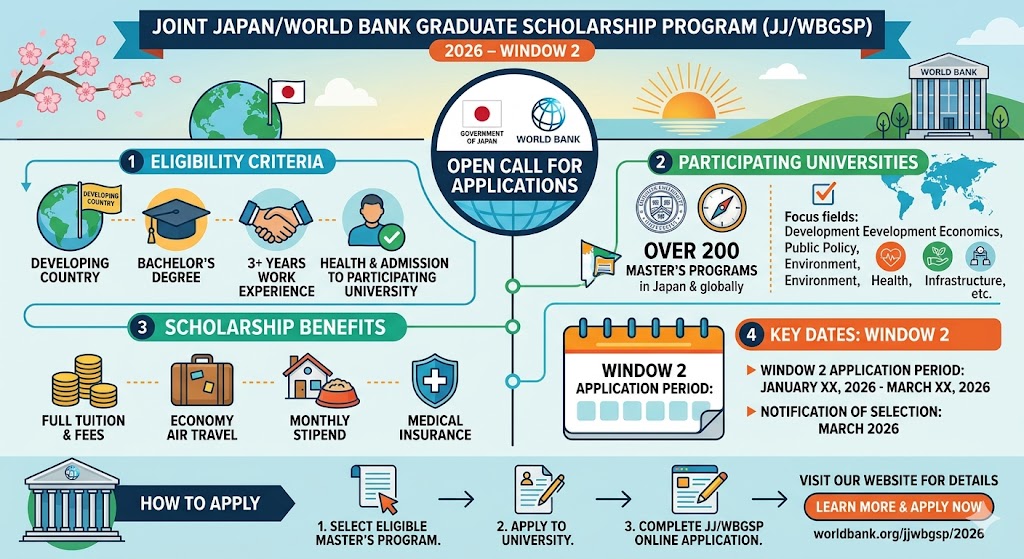
Scholarship Overview (Window 2 Only)
- Scholarship Type: Full funding (tuition + living stipend + travel + insurance)
- Degree Level: Master’s
- Eligible Fields: Development-related disciplines (economic policy, public policy, infrastructure, tax policy, climate change, health, environment, etc.)
- Eligible Applicants: Nationals of eligible developing World Bank member countries (not dual nationals of developed countries)
- Study Locations: Universities in the United States, Europe, Africa, Oceania, and Japan
- Application Window 2: March 30 – May 29, 2026 (noon EST)
Why JJ/WBGSP Exists — And Why It Is Highly Selective
The program exists to close the persistent gap between global development knowledge and effective local implementation in developing countries. It deliberately targets professionals who:
- Already work inside government, public institutions, or development organizations
- Understand local political, economic, and institutional constraints
- Can translate advanced tools and frameworks into practical solutions back home
The return-home commitment is absolute. Scholars must demonstrate a concrete, realistic plan to apply their new skills immediately upon completion. This is why the selection process heavily weights proven experience and post-study contribution over pure academic potential.
JJ/WBGSP 2026 Window 2 Eligibility – The Strict 3-3-3 Rule
To pass initial screening, you must satisfy all of the following (no exceptions for standard applicants):
- Bachelor’s degree at least 3 years old by the application deadline (May 29, 2026).
- At least 3 years of paid, full-time development-related employment, acquired within the past 6 years before the deadline.
- Currently employed in a paid, full-time, development-related position at the time of application.
Development-related work includes roles in:
- Government ministries and public agencies
- Public health, infrastructure, environmental management, or tax administration
- Economic policy, project implementation, or regulatory bodies
Nationals from fragile and conflict-affected states (FCS) receive some flexibility regarding employment opportunities, but must still provide proof of successive employment history.
How to Apply for JJ/WBGSP 2026 Window 2 (Step-by-Step)
The process is indirect and unforgiving:
- Secure unconditional admission (except for funding) to at least one Window 2 participating master’s program located outside your country of citizenship and residence.
- Receive the scholarship application link — this is typically shared only with candidates who have been admitted and shortlisted by the participating university.
- Submit one complete online scholarship application by May 29, 2026, noon EST.
- Provide exactly two professional recommendation letters (submitted online by your recommenders). Academic references are not accepted in place of professional ones.
Important: You may submit only one application. Multiple submissions lead to disqualification.
The Gatekeeper: Window 2 Participating Programs
Admission to a participating program is the real filter. The official 2026 Window 2 list includes programs at institutions such as:
- Australian National University (Crawford School of Public Policy) — e.g., Master of Climate Change, Master of Public Policy
- Columbia University, Brandeis University (Heller School), and other top programs in the US, Europe, Japan, Africa, and Oceania
The full, updated list of Window 2 programs is available on the official World Bank JJ/WBGSP page. Choose programs where your professional background creates a natural, compelling narrative — not just the most prestigious name.
Scholarship Benefits and Realistic Costs
Covered:
- Full tuition
- Monthly living stipend (varies by host country cost of living)
- Round-trip air travel (economy)
- $600 travel allowance per trip
- Basic medical insurance
Not covered (prepare for these):
- Visa and residency permit fees
- Family relocation or support
- Laptop, research materials, or additional equipment
- Any gap between stipend and actual living costs in expensive cities
How Applications Are Scored (Official Weights)
Two independent assessors score each eligible application on a 1–10 scale. The final score is based on:
- Quality of Professional Experience — 30% (measurable impact, projects led, policies influenced)
- Quality of Professional Recommendations — 30% (specific, evidence-based letters from supervisors or senior colleagues)
- Quality of Commitment to Home Country — 30% (concrete, realistic post-study plan with clear development outcomes)
- Quality of Educational Background — 10% (relevant but secondary once eligibility is met)
Cohesion across all four elements is critical. Assessors also consider gender balance, geographic distribution, and, in tiebreakers, financial need.
Master Strategy: Building a Winning Application
Your application must tell one clear story:
A specific development challenge in your country → Your current professional contribution → The precise skills/knowledge gap the chosen program will fill → Your concrete role and measurable impact upon return.
Avoid emotional storytelling. Write like a policymaker presenting a project proposal.
Recommendation Letters: Choose referees who can describe your achievements with concrete examples (“led a team that improved X by Y%” beats “hardworking and dedicated”).
Who Should Apply (Window 2)
Strong Candidates:
- Mid-career professionals with 3–10+ years of relevant paid experience
- Government or public-sector practitioners with tangible impact
- Applicants with a clear, specific return plan tied to national priorities
Weak Candidates (likely to be rejected):
- Recent graduates or those with insufficient professional experience
- Individuals primarily seeking migration or personal advancement
- Applicants with generic or vague career goals
Common Reasons Strong Applicants Still Fail
- Generic or weak professional recommendation letters
- Personal statement that lacks policy depth and cohesion
- Failure to secure unconditional admission to a Window 2 program in time
- Mismatch between past experience, chosen program, and future role
- Submitting after the strict May 29, 2026 noon EST deadline
Final Verdict: Is JJ/WBGSP Window 2 2026 Worth It?
Yes — if you are already a builder contributing to your country’s development systems.
This scholarship is one of the most powerful accelerators available for professionals who want to scale their impact. It is not an opportunity for exploration or a second chance at academics.
If you have a proven track record, understand your country’s constraints deeply, and can articulate exactly how the master’s will help you deliver better results back home, then apply strategically and with discipline.
If not, focus on gaining the required experience first. Stronger applications come from those who wait until they genuinely qualify.
Final Checklist for Window 2 2026 Applicants
- Confirm you meet the strict 3-3-3 eligibility criteria.
- Review the official Window 2 participating programs list and apply early to 2–3 suitable ones.
- Secure unconditional admission (except funding) before the scholarship deadline.
- Identify two strong professional referees who can speak to your impact.
- Draft a policy-focused statement that links your experience → program → future contribution.
- Prepare all documents (CV in required format, degree certificate, proof of employment, passport).
- Submit only one complete application by May 29, 2026, noon EST.
This program rewards substance over aspiration. If you are already shaping your country’s future in a development-related role, JJ/WBGSP Window 2 can provide the advanced tools and network to do it at a higher level.
Start preparing your university applications now. Time is tight for Window 2.