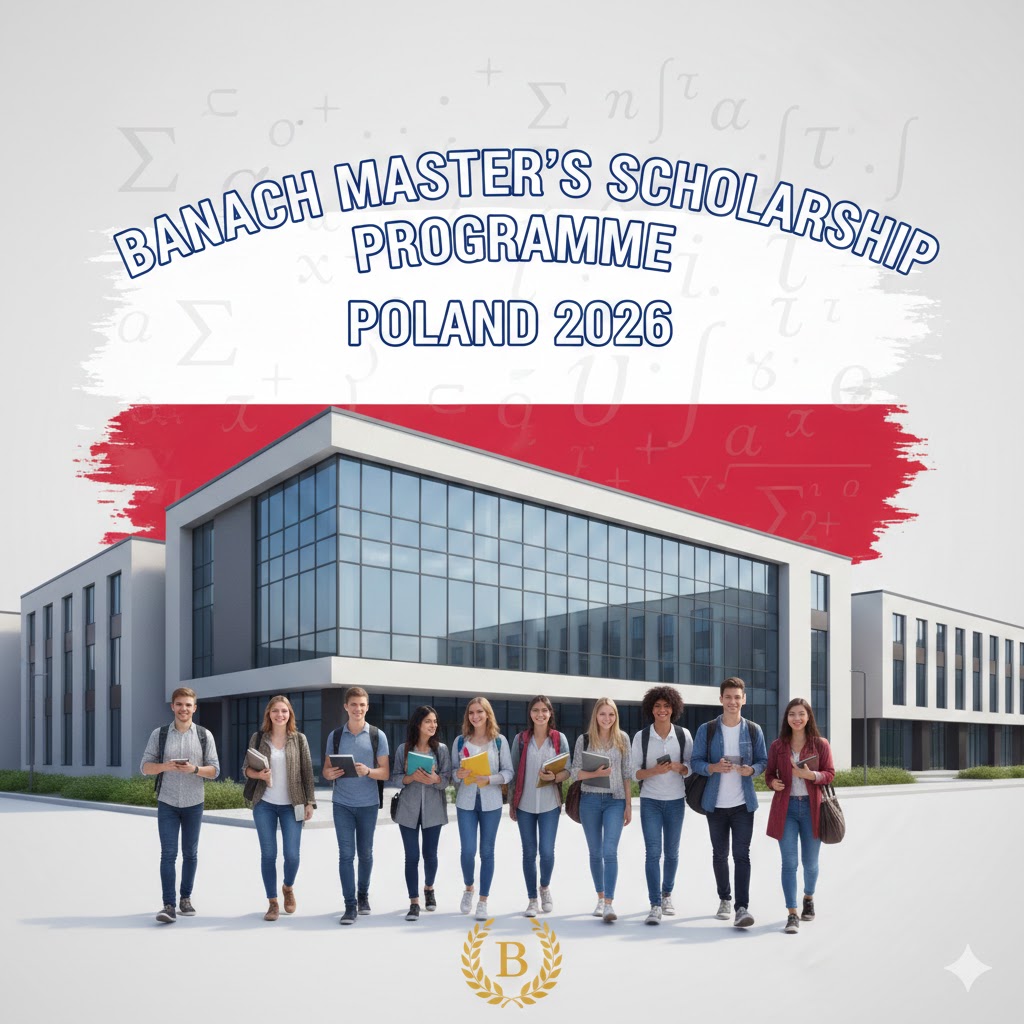
The Banach Master’s Scholarship Programme in Poland 2026
Every year, many qualified graduates from developing countries miss out on the Banach Scholarship Programme. This is not because they are unqualified, but because they misunderstand the programme’s actual purpose. This scholarship is not a generic European funding scheme, nor is it purely merit-based in the traditional sense. The Banach Scholarship Programme is a development-focused initiative. It is policy-driven. It was created to strengthen human capital in specific countries. It accomplishes this by supporting second-degree (Master’s) studies in Poland. Understanding this objective is critical if you want to apply successfully.
If you are considering studying in Poland in English or Polish, this guide is for you. Check if your country is on the eligibility list. If it is, this guide will help you. It explains how the Banach Scholarship really works. You will understand who it favors and where most applicants go wrong.
Scholarship Overview
- Scholarship Type: Fully Funded (Polish Development Aid)
- Degree Level: Master’s (Second-degree studies only)
- Eligible Fields: Engineering, science, economics, agriculture, environmental studies, social sciences, and other development-relevant fields
- Eligible Students: Citizens of selected developing countries
- Study Location: Poland
- Language of Study: Polish or English
- Administered By: Polish National Agency for Academic Exchange (NAWA)
Banach Scholarship eligibility is strictly country-based and limited to Master’s-level applicants.
About the Banach Scholarship Programme
The Banach Scholarship Programme is a collaboration. It involves Poland’s Ministry of Foreign Affairs and the Polish National Agency for Academic Exchange (NAWA). It operates under Poland’s official development aid framework and is supervised by the Minister of Science and Higher Education. The core mission of the programme is to contribute to the socio-economic development of partner countries by educating future specialists, policymakers, and professionals in Poland.
This development-driven purpose means the selection committee prioritizes applicants. Their academic plans must clearly link to long-term impact in their home countries. Applicants who treat the scholarship as a pathway to migration or unrelated career shifts are rarely selected.
Eligible Countries
Only citizens of the following countries may apply for the Banach Scholarship Programme:
Albania, Angola, Argentina, Armenia, Azerbaijan, Belarus, Bosnia and Herzegovina. Brazil, Georgia, India, Indonesia, Iran, Iraq, Jordan, Kazakhstan, Kenya, Kosovo. Lebanon, Mexico, Moldova, Mongolia, Montenegro. Nigeria, North Macedonia, Palestine, Papua New Guinea, Peru, Philippines, Rwanda. Senegal, Serbia, Tanzania, Tunisia, Ukraine, Uzbekistan, Vietnam.
Citizenship eligibility is non-negotiable. Dual citizens must apply using a passport from an eligible country.
What Makes the Banach Scholarship Different
Many European scholarships focus primarily on academic excellence. Unlike these, the Banach Scholarship Programme evaluates applicants through a development impact lens. What matters most is not only what you want to study. It is also important to understand why you want to study it. Additionally, consider how that education will benefit your country after graduation.
Key distinguishing features include:
- Alignment with Poland’s development cooperation priorities
- Focus on capacity-building rather than brain drain
- Support for studies in both English and Polish
- Central coordination by NAWA rather than individual universities
This makes the programme particularly suitable for applicants with public-sector, research, or development-oriented career goals.
Fields of Study and Academic Focus
While the official call may list many eligible fields, successful applicants typically choose programmes related to:
- Engineering and technology
- Environmental protection and climate studies
- Agriculture and food systems
- Economics, finance, and development studies
- Public administration and policy
- International relations
- Health sciences (non-clinical)
Choosing a field unrelated to development priorities is one of the most common strategic mistakes.
Language of Instruction: Polish or English
Applicants may apply for programmes taught in English or Polish. English-taught programmes are more competitive due to limited availability. Polish-taught programmes may require preparatory language training, which is sometimes supported under the scholarship framework.
Applicants should not assume that English-taught programmes are easier to access. In practice, Polish-taught programmes often offer broader field availability.
Financial Coverage and Benefits
The Banach Scholarship Programme is considered fully funded for the duration of Master’s studies.
Covered Costs
- Monthly stipend
- Tuition fees at public universities
- Possible preparatory courses
- Institutional support through NAWA
Costs Not Fully Covered
- Travel to and from Poland
- Residence permit fees
- Health-related costs not covered by insurance
- Books and academic materials
- Initial settlement expenses
Funding delays during the first month are possible, so applicants should plan limited personal savings.
Application Process Explained
Applications are submitted during an official call for proposals announced by NAWA. The process generally involves:
- Reviewing the annual call and eligible fields
- Selecting suitable Master’s programmes in Poland
- Preparing academic and supporting documents
- Submitting an online application through the NAWA system
- Awaiting evaluation and final decision
Calls are time-limited, and late submissions are not considered.
Required Documents
Typical application documents include:
- Valid passport
- Bachelor’s degree diploma
- Academic transcripts
- Curriculum vitae (CV)
- Motivation letter
- Proof of language proficiency (if required)
- Additional documents specified in the call
All documents must be clear, consistent, and professionally presented.
Motivation Letter: The Deciding Factor
For the Banach Scholarship Programme, the motivation letter often carries more weight than GPA alone. Strong letters:
- Clearly explain the applicant’s academic background
- Justify the chosen Master’s programme
- Link studies to national development challenges
- Outline realistic post-graduation plans
- Demonstrate commitment to returning home
Generic statements about studying in Europe or improving personal finances significantly reduce selection chances.
Who Should Apply
The programme is ideal for:
- Graduates from eligible countries
- Applicants with development-relevant academic backgrounds
- Public-sector or NGO professionals
- Candidates planning to return home after graduation
- Students interested in policy, research, or institutional reform
Who Should Not Apply
The Banach Scholarship Programme is not suitable for:
- Applicants seeking undergraduate or PhD funding
- Candidates focused on permanent migration
- Students without a clear development objective
- Applicants choosing unrelated fields of study
Understanding this distinction saves time and prevents avoidable rejection.
Why Applications Fail
Common reasons for rejection include:
- Weak development justification
- Poor field-to-country relevance
- Generic motivation letters
- Incomplete documentation
- Misunderstanding programme objectives
Academic strength alone does not compensate for strategic misalignment.
Poland as a Study Destination
Poland offers high-quality public universities, affordable living costs, and increasing numbers of English-taught programmes. Degrees are fully recognized across the European Union. This recognition makes Poland an attractive destination for development-focused education. Students can benefit from education without the cost barriers of Western Europe.
For Banach Scholars, studying in Poland offers exposure to a country. Poland has itself transitioned successfully through economic reform. It has also gone through institutional reform.
Conclusion
The Banach Scholarship Programme is a serious, policy-oriented opportunity, not a mass scholarship. Applicants who understand its development mission, choose appropriate fields, and present coherent post-study plans stand a realistic chance of success. Those who apply casually or strategically misaligned are unlikely to progress.
If your academic goals align with national development priorities, the Banach Scholarship Programme can be a highly strategic investment. It prepares you for structured Master’s study in Poland. This investment benefits your future and your country’s progress.
⏰ Deadline passed - applications closed!

Related Posts
Empowering the Future of Secure AI: The Singapore AI Safety Fellowship 2026 (Fully Funded)
Matsumae International Foundation (MIF) Japan Fellowship 2027: A Fully Funded Opportunity for Global Researchers